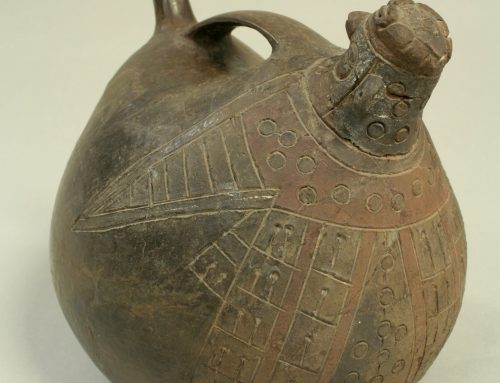
Double Spout and Bridge Bottle with Trophy Head
Date: 2nd century B.C. – A.D. 1st century
Geography: Peru
Culture: Topará
Medium: Ceramic
Dimensions: H. 7 1/4 x W. 5 5/8 x D. 5 1/2 in. (18.4 x 14.3 x 14 cm)
Classification: Ceramics-Containers
Credit Line: The Michael C. Rockefeller Memorial Collection, Gift of Nelson A. Rockefeller, 1969
Accession Number: 1978.412.98
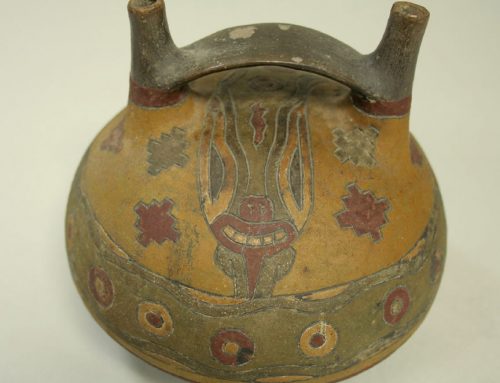
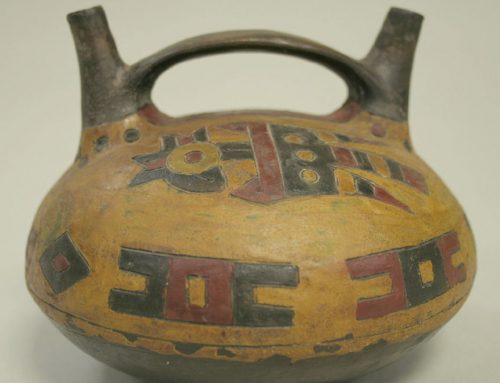
This double spout and bridge bottle’s body is in the shape of a trophy head. Facial features are created with appliqué and incisions. “Trophy heads” represent severed heads is connected to ritual warfare which is a prevalent theme in Andean imagery. Actual trophy heads of humans have been documented in the archaeological record. This idea of a trophy head is reproduced here as a ceramic vessel.
Almond shaped, closed eyes are created by a single incision on each eye illustrating death. The trophy head’s mouth is slightly open, and contrasts with the Miniature effigy vessel (63.232.88) with a closed mouth. Topará is a distinct culture that co-existed with Paracas. Topará ceramics overall contrast with Paracas ceramics as they use a limited color palette. In addition to their use of different colors, the method of which pigments were applied to Topara ceramics is also different. Colored slips were applied to Topará ceramics before the vessel was fired in a kiln. This contrasts to the typical Paracas method of applying bright, colored pigments after the vessel was fired.